
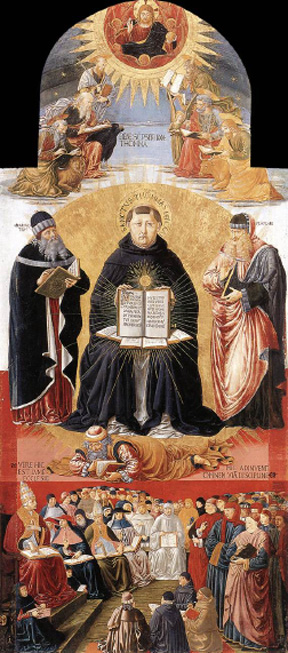
 The words of Popes down through the centuries concerning St. Thomas Aquinas, author of the Summa Theologiae:
Innocent VI (c. 1352-1362): “His teaching above that of others, the canonical writings alone excepted, enjoys such a precision of language, an order of matters, a truth of conclusions, that those who hold to it are never found swerving from the path of truth, and he who dare assail it will always be suspected of error.”
Urban V (1368), to the University of Toulouse: “It is our will, which We hereby enjoin upon you, that ye follow the teaching of Blessed Thomas as the true and Catholic doctrine and that ye labor with all your force to profit by the same.”
Pius V (1567): Declared St. Thomas Aquinas a Doctor of the Church.
Leo XIII (1879): “The doctrines of these illustrious men [the Church Fathers], like the scattered members of a body, Thomas collected together and cemented, distributed in wonderful order, and so increased with important additions that he is rightly and deservedly esteemed the special bulwark and glory of the Catholic faith.”
“Moreover, the Angelic Doctor pushed his philosophic inquiry into the reasons and principles of things, which because they are most comprehensive and contain in their bosom, so to say, the seeds of almost infinite truths, were to be unfolded in good time by later masters and with a goodly yield.”
“And as he also used this philosophic method in the refutation of error, . . . he victoriously combated the errors of former times, and supplied invincible arms to put those to rout which might in aftertimes spring up.”
Pius X (1914): “The principles of philosophy laid down by St. Thomas Aquinas are to be religiously and inviolably observed, because they are the means of acquiring such a knowledge of creation as is most congruent with the Faith; of refuting all the errors of the ages, and of enabling man to distinguish clearly what things are to be attributed to God and to God alone.”
“The principles of St. Thomas, considered generally and as a whole, contain nothing but what the most eminent philosophers and doctors of the Church have discovered after prolonged reflection and discussion in regard to the particular reasons determining human knowledge, the nature of God and creation, the moral order and the ultimate end to be pursued in life.”
“The capital theses in the philosophy of St. Thomas are not to be placed in the category of opinions capable of being debated one way or another, but are to be considered as the foundations upon which the whole science of natural and divine things is based; if such principles are once removed or in any way impaired, it must necessarily follow that the students of the sacred sciences will ultimately fail to perceive so much as the meaning of the words in which the dogmas of divine revelation are proposed by the magistracy of the Church.”
Pius XI (1923): “In dealing orally or in writing with divine things, he provides theologians with a striking example of the intimate connection which should exist between the spiritual and the intellectual life. For just as a man cannot be really said to know some distant country, if his acquaintance is confined merely to a description of it, however accurate, but must have dwelt in it for some time; so nobody can attain to an intimate knowledge of God by mere scientific investigation, unless he also dwells in the most intimate association with God. The aim of the whole theology of St. Thomas is to bring us into close living intimacy with God.”
“He insists that all who undertake to defend the Christian faith shall hold sacrosanct the principle that: ‘It is not mere folly to assent to the things of faith though they are beyond reason’ (Contra Gentes, I, vi). He shows that, although the articles of belief are mysterious and obscure, the reasons which persuade us to believe are nevertheless clear and perspicuous, for, says he, ‘a man would not believe unless he saw that there were things to be believed’ (II-II, i, 4).”
Pius XII (1939): “Emulation in seeking and propagating the truth is not supressed, but is rather stimulated and given its true direction by commending the teaching of St. Thomas.”
(1950): “If one considers all this well, he will easily see why the Church demands that future priests be instructed in philosophy ‘according to the method, doctrine, and principles of the Angelic Doctor,’ since, as we well know from the experience of centuries, the method of Aquinas is singularly preeminent both of teaching students and from bringing truth to light; his doctrine is in harmony with Divine Revelation, and is most effective both for safeguarding the foundation of the faith and for reaping, safely and usefully, the fruits of sound progress.”
Paul VI (1964): “For so great is the power of the Doctor’s genius, so sincere his love of truth, and so great his wisdom in investigating the deepest truths, in illustrating them, and linking them together with a most fitting bond of unity, that his teaching is a most efficacious instrument not only for safeguarding the foundations of faith, but also in gaining the fruits of healthy progress with profit and security.”
John Paul II ( 1998 ): “Profoundly convinced that ‘whatever its source, truth is of the Holy Spirit’ (omne verum a quocumque a Spiritu Sancto est), St. Thomas was impartial in his love for truth. He sought truth wherever it might be found and gave consummate demonstration of its universality. In him, the Church’s Magisterium has seen and recognized the passion for truth; and, precisely because it stays consistently within the horizon of universal, objective, and transcendent truth, his thought scales ‘heights unthinkable to human intelligence.’ Rightly then, he may be called an ‘apostle of the truth.’ Looking unreservedly to truth, the realism of Thomas could recognize the objectivity of truth and produce not merely a philosophy of ‘what seems to be’ but a philosophy of ‘what is.’”



 NovAntiqua